
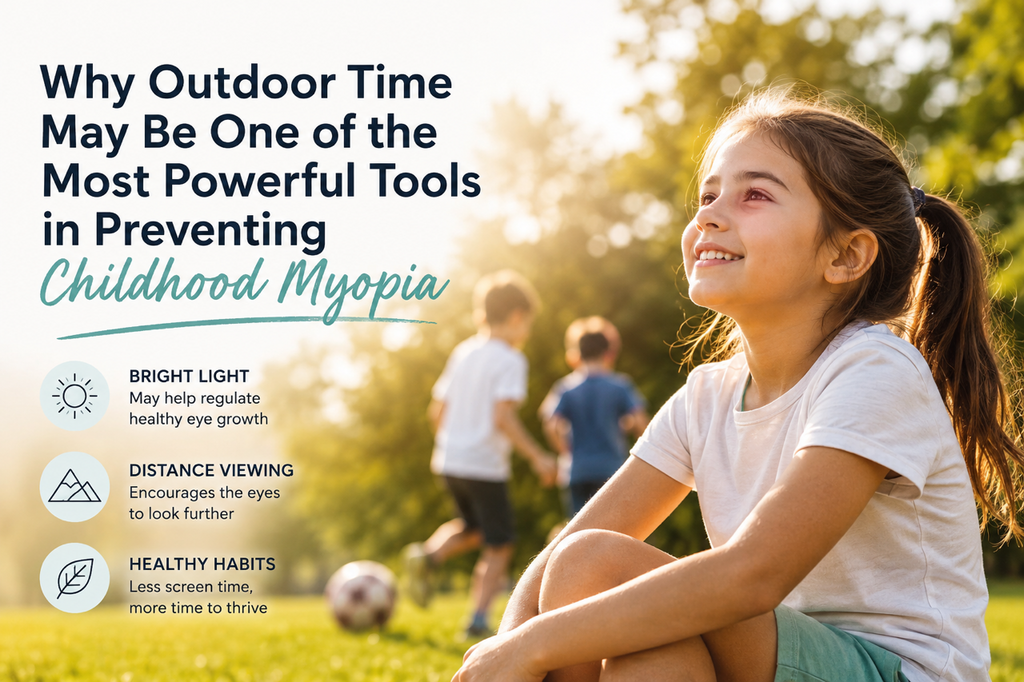
Why Outdoor Time May Be One of the Most Powerful Tools in Preventing Childhood Myopia.
In a world where screens, homework, tablets, gaming, and indoor entertainment dominate childhood, one surprisingly simple habit is gaining serious attention from global eye health experts:
Spending more time outdoors.
The globally respected Brien Holden Vision Institute (BHVI) has recently updated its myopia risk calculator to include outdoor time as a measurable risk factor when assessing a child’s likelihood of developing myopia (short-sightedness).
That is significant.
For years, parents have heard advice like “encourage more outdoor play”, but the science is becoming increasingly clear. Daily lifestyle habits may play a genuine role in how a child’s eyes develop.
For Australian families, this presents both an opportunity and a warning.
What Is Myopia?
Myopia, also known as short-sightedness, occurs when the eye grows longer than it should from front to back. This causes light to focus incorrectly inside the eye, making distant objects appear blurry while close-up vision often remains clear.
But modern myopia management is no longer simply about prescribing glasses.
Higher levels of myopia are associated with an increased lifetime risk of serious eye health conditions, including retinal detachment, myopic macular degeneration, glaucoma, and earlier cataract development.
This is why early intervention matters.
The goal is no longer just clearer vision today, it is protecting long-term eye health for the future.
Why Does Outdoor Time Help Reduce Myopia Risk?
Researchers continue to study the exact biological mechanisms, but several strong theories explain why spending time outdoors may help reduce the risk of developing childhood myopia.
Bright Natural Light Exposure
Outdoor light levels are dramatically higher than most indoor environments.
Exposure to bright natural light appears to stimulate the release of dopamine within the retina, which may help regulate normal eye growth and reduce excessive elongation of the eye. This is currently one of the most widely accepted explanations.
Less Prolonged Near Work
When children spend more time outdoors, they are naturally spending less time doing sustained close-up tasks such as reading, gaming, using tablets, phones, or completing homework at close distances.
While screens are not the sole cause, prolonged close focus without regular visual breaks may contribute to eye strain and myopia progression.
More Visual Variety
Outdoor environments encourage the visual system to work differently. Children naturally spend more time looking into the distance, tracking moving objects, changing focus, and using depth perception.
Compared with staring at a fixed close distance indoors, this creates a far more dynamic visual environment that may support healthier eye development.
How Much Outdoor Time Is Recommended?
Current guidance commonly suggests around two hours outdoors each day.
The good news is that this does not need to mean organised sport.
Simple daily habits such as walking to school, backyard play, bike riding, park visits, or family walks can all contribute.
Small lifestyle habits, repeated consistently, can make a meaningful difference over time.
Of course, outdoor activity should always be balanced with sensible sun protection, including hats, sunscreen, and appropriate sunglasses where needed.
Why This Matters for Australian Families
Australia has one significant advantage: an outdoor lifestyle.
Yet despite this, childhood screen use continues to rise.
Digital learning, streaming entertainment, gaming, and portable devices mean many children now spend significantly more time indoors than previous generations.
Globally, experts predict that half the world’s population may be myopic by 2050.
That makes prevention and early management more important than ever.
A Changing Conversation in Eye Care
The fact that BHVI has added outdoor time into its myopia risk calculator reflects an important shift in modern eye care.
The conversation is no longer simply about correcting blurred vision with glasses.
It is about identifying risk early and actively managing future eye health.
For parents, that is empowering.
Because while genetics certainly play a role, lifestyle habits may also influence outcomes.
When Should Parents Have Their Child’s Eyes Checked?
If your child tends to hold devices very close, squints to see distant objects, complains of headaches, moves closer to the television, or has one or both parents who are short-sighted, it may be worth arranging a comprehensive children’s eye examination.
Early detection creates more options for management.
Final Thought
Sometimes the most powerful health interventions are not the most complicated.
A pair of shoes.
Fresh air.
A soccer ball.
A bike ride.
And perhaps two extra hours outdoors.
Your child’s eyes may thank you for it.
Book a Children’s Eye Examination in Perth
If you are concerned about your child’s vision, myopia risk, or increasing screen time, our team at Spex Design Optometrist can help assess their eye health and discuss modern myopia management options.
Early action matters.
Related post
11
Aug
20
May
RECENT POSTS
11.August.2026
Australia’s First Rodenstock DNEye® Scanner 3 Arrives at Spex Design Optometrist
0 Comments
20.May.2026
Why Outdoor Time May Be One of the Most Powerful Tools in Preventing Childhood Myopia.
0 Comments