
The Science Behind Rodenstock's B.I.G. EXACT Technology: Why Your Lenses Should Be as Unique as Your Eyes
Most people assume that once they have their prescription, any lens will do. After all, a minus-two is a minus-two, right? The truth is far more nuanced and understanding why could fundamentally change how you experience the world through your glasses.
At Spex Design, we have been fitting Rodenstock's B.I.G. EXACT lenses for years, and more recently their latest evolution, B.I.G. EXACT Sensitive. In this post, we want to take you behind the marketing and into the actual science the engineering, the optics, and the neuroscience that makes these lenses unlike anything else available today.
The Problem with "Standard" Lenses
To appreciate what B.I.G. EXACT does differently, it helps to understand what happens when you get a conventional pair of glasses.
A standard eye test produces four key prescription values: sphere, cylinder, axis, and addition (for progressive wearers). These numbers are then fed into a lens calculation that relies on what the optical industry calls the reduced eye model. It’s a simplified, averaged representation of the human eye that was established decades ago. It assumes a standard corneal curvature, a standard eye length, a standard pupil behaviour, and standard internal optics.
The problem? According to Rodenstock's own research, these standard values accurately represent only about 2% of eyes. The remaining 98% of us are wearing lenses calculated for someone else's eye geometry. They work but they are an approximation, not a solution. For many wearers, especially those in progressive lenses, this gap between the model and reality manifests as subtle but persistent issues: slightly blurred peripheral vision, a narrow "sweet spot" for reading, discomfort when transitioning between distances, and that unsettling "swim effect" when turning the head.
Enter Biometric Intelligent Glasses
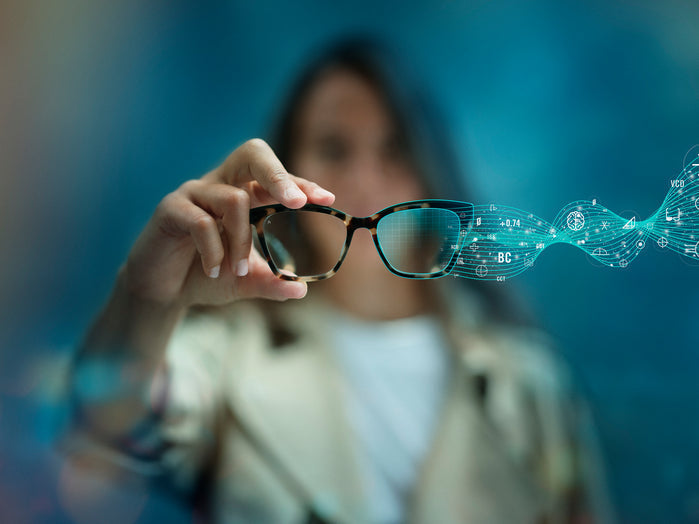
Rodenstock's response to this problem was not incremental it was foundational. Rather than refining the old model, they built an entirely new approach: Biometric Intelligent Glasses (B.I.G.), which replace the generic eye model with a precise, individual biometric profile of each wearer's eyes.
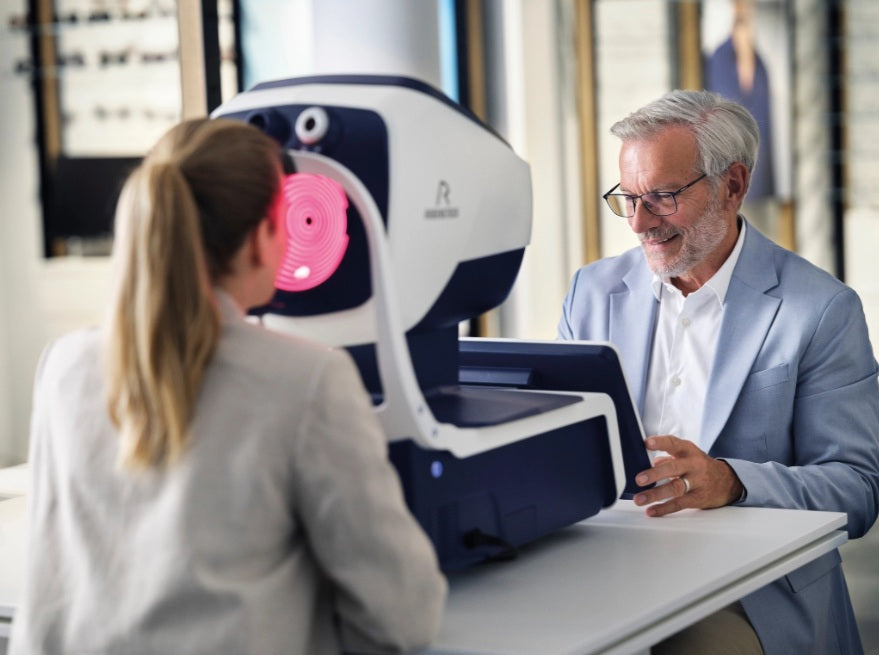
The cornerstone of this approach is the DNEye Scanner, a diagnostic instrument that captures a comprehensive map of the eye's optical system. Unlike a standard refraction, which measures how light bends through the eye at a single point, the DNEye Scanner records over 7,000 data points and more than 80 individual parameters per eye. These include:
|
Parameter Category |
What It Measures |
|
Wavefront aberrations |
Both lower-order (sphere, cylinder) and higher-order aberrations at far and near distances |
|
Pupil dynamics |
Photopic (bright light) and mesopic (dim light) pupil sizes at far and near |
|
Corneal topography |
The precise curvature and shape of the cornea's surface |
|
Internal eye dimensions |
Anterior chamber depth, vitreous chamber depth, and total axial eye length |
|
Crystalline lens power |
The refractive contribution of the eye's internal lens |
The measurement is fully automatic, uses intelligent eye tracking to ensure accuracy, and transmits results to 1/100th of a dioptre precision via Rodenstock's WinFit Reference system. The entire scan takes just a few minutes and requires no drops, no discomfort, and no special preparation.
From Data to Lens: How the Biometric Eye Model Works
Once the DNEye Scanner has captured the raw data, Rodenstock's proprietary algorithms construct what they call an exact biometric eye model. A digital twin of the wearer's complete visual system. This model accounts for every optical surface, every refractive index, every aberration, and every dimensional measurement that influences how light travels through that specific eye.
This is fundamentally different from the traditional approach. A conventional lens is calculated by optimising a single surface (the back curve of the lens) against the reduced eye model. A B.I.G. EXACT lens is calculated by optimising every point on the lens surface against the wearer's actual, measured eye geometry. The result is a lens where the optical correction is precise not just at the centre, but across the entire field of view.
The clinical impact is significant. Rodenstock's data shows that B.I.G. EXACT lenses deliver up to 40% sharper vision at near and intermediate distances and an 8.5-degree wider field of sharp vision at near compared to lenses calculated using the standard eye model. In a survey of 283 wearers, 92% reported sharper vision, 88% noticed greater visual comfort, 84% experienced better contrast vision, 80% reported improved vision at dusk, and 87% experienced reduced adaptation time.

The Breakthrough: Visual Sensitivity
If B.I.G. EXACT was the first revolution, replacing the average eye model with an individual one then B.I.G. EXACT Sensitive is the second: recognising that two people with identical eye biometry can still experience vision very differently.
This insight came from Rodenstock's research into what they call the Visual Sensitivity Index. Visual sensitivity refers to how the brain responds to the optical imperfections (aberrations) that are inherent in any lens. Every progressive lens, no matter how well made, introduces some degree of unwanted distortion in the peripheral zones. The question is: how much does your brain notice?
Rodenstock discovered that visual sensitivity exists on a spectrum:
|
Sensitivity Level |
Characteristics |
Lens Design Implication |
|---|---|---|
|
High visual sensitivity |
Highly sensitive to distortions |
More controlled aberration zones |
|
Low visual sensitivity |
Tolerates imperfections |
Smoother transitions, wider distribution |
This distinction matters because it explains a phenomenon that optometrists have observed for decades: why some patients adapt to new progressive lenses within hours while others struggle for weeks, even when the prescription and lens quality are identical. The answer, it turns out, lies not in the eyes but in the brain.
The Neuroscience of Seeing
To fully appreciate why visual sensitivity matters, it helps to understand a fundamental truth about human vision: you do not see with your eyes you see with your brain.
The eyes are optical instruments that capture light and convert it into electrical signals. But the construction of a coherent visual experience — depth, colour, motion, spatial awareness happens entirely in the visual cortex. The brain is constantly interpreting, filtering, and compensating for the raw data it receives from the eyes.
Human vision operates through two interconnected subsystems. Focus vision is responsible for detailed, high-resolution sight — reading text, recognising faces, examining fine detail. Peripheral vision handles orientation, motion detection, and spatial awareness — navigating a crowded footpath, detecting a car approaching from the side, maintaining balance while walking.
Our eyes move approximately 250,000 times per day, constantly shifting between these two subsystems. Peripheral vision identifies a point of interest; focus vision locks onto it for detailed analysis; the brain integrates both streams into a seamless experience. This dynamic interplay is what Rodenstock calls visual flow.
A well-designed progressive lens must support both subsystems simultaneously. If the peripheral zones introduce too much distortion for a high-sensitivity wearer, the brain has to work harder to compensate leading to fatigue, discomfort, and that vague sense that something is "off." Conversely, if the lens over-constrains aberrations for a low-sensitivity wearer, it may unnecessarily narrow the usable field of view without any perceptible benefit.
B.I.G. EXACT Sensitive is the first lens to account for this. By integrating the Visual Sensitivity Index into the lens calculation alongside the full biometric eye model, Rodenstock creates a lens that is optimised not just for the eye, but for the entire visual system — eyes and brain working together.
What the Clinical Evidence Shows
Rodenstock validated the B.I.G. EXACT Sensitive concept through a controlled wearer trial conducted with the University of Applied Sciences in Munich in June 2024, involving 47 participants. The results were striking:
|
Metric |
Improvement |
|
Wearers who preferred the Sensitive design over their previous lenses |
83% |
|
Better transitions between distances |
+24% |
|
Improved comfort in near-to-intermediate ranges |
+28% |
|
Improved visual orientation across fields |
+35% |
These are not marginal gains. A 24% improvement in distance transitions means noticeably smoother shifts between reading your phone and looking up at the road. A 35% improvement in orientation means more confident spatial awareness when walking, driving, or navigating complex environments.
The technology has also been recognised by the industry. B.I.G. EXACT Sensitive has received four major awards: the German Innovation Award, the Silmo d'Or (the optical industry's equivalent of an Oscar), the Gold Medal of Grupa MTP, and the Lens Award at the Optician Awards.

What We See at Spex Design
Beyond the published data, our own experience fitting B.I.G. EXACT Sensitive lenses in Perth have been consistently positive. Clients report that reading feels smoother and less effortful, that driving at night is calmer with less glare from oncoming headlights, and that the transition between screen work and distance vision feels almost seamless.
One particularly telling case involved a long-time progressive lens wearer who had always experienced a subtle "swim effect" that disorienting sensation of the world shifting when turning the head. After switching to B.I.G. EXACT Sensitive, she reported that the sensation was virtually gone within hours. Another client, a woman in her sixties who spends significant time at a computer, described the new lenses as "following her gaze". The intermediate zone felt wider and more natural than anything she had worn before.
These experiences align with the science. When the lens is calculated for the individual's complete biometric profile and visual sensitivity, the brain receives optical input that is more consistent with what it expects. Less compensation is needed, adaptation is faster, and the overall experience is more comfortable and natural.
Is It Worth It?
The honest answer is for most progressive lens wearers, yes and the more visually demanding your lifestyle, the greater the benefit.
If you spend significant time switching between screens and distance vision, if you drive regularly (especially at dusk or night), if you have ever felt that your progressive lenses are "almost right but not quite," or if you have struggled with adaptation in the past, then lenses calculated from your actual biometric data and visual sensitivity profile will deliver a measurably and perceptibly better experience.
It is worth noting that not every wearer will experience a dramatic transformation. Those with lower visual sensitivity may find the improvements more subtle — smoother transitions, slightly less fatigue at the end of the day. But even subtle improvements, compounded across the 250,000 eye movements you make every day, add up to a meaningfully better quality of vision.
The Bottom Line
Rodenstock's B.I.G. EXACT technology represents a genuine paradigm shift in how spectacle lenses are designed and manufactured. By replacing the century-old, reduced eye model with a complete biometric profile and now incorporating the neuroscience of visual sensitivity they have created lenses that work with the individual's entire visual system rather than approximating it.
As Rodenstock themselves put it: "This is not personalisation. This is biometric individualisation."
If you would like to learn more or experience the difference for yourself, we invite you to book a consultation at Spex Design. Your eyes and your brain will thank you.
Spex Design Optometrist
North Perth, Western Australia
(08) 9328 2944 | spexdesign.com.au
References:
[1] Rodenstock, "B.I.G. VISION FOR ALL," rodenstock.com/bigvision.
[2] Rodenstock, "DNEye Scanner 2/2+," rodenstock.us/ecp/dneye-scanner.
[3] Rodenstock, "DNEye Scanner 2/2+ Features," rodenstock.us/ecp/dneye-scanner.
[4] Rodenstock / BetterSpectacles, "The #1 Vision Innovation of the Decade," betterspectacles.com.
[5] DNEye customer survey (2018), Zurich. Cited on rodenstock.com/bigvision.
[6] mivision, "B.I.G. Exact Sensitive," mivision.com.au, March 2025.
[7] Rodenstock, "B.I.G. EXACT Sensitive," rodenstock.com/bigvision/big-exact-sensitive.
[8] External wearer trial (n=47), University of Applied Sciences Munich, June 2024. Cited on rodenstock.com.
[9] Rodenstock, "Award-winning B.I.G. EXACT Sensitive," rodenstock.com/bigvision/big-exact-sensitive.
Related post
11
Aug

20
May
RECENT POSTS

11.August.2026
Australia’s First Rodenstock DNEye® Scanner 3 Arrives at Spex Design Optometrist
0 Comments
20.May.2026
Why Outdoor Time May Be One of the Most Powerful Tools in Preventing Childhood Myopia.
0 Comments